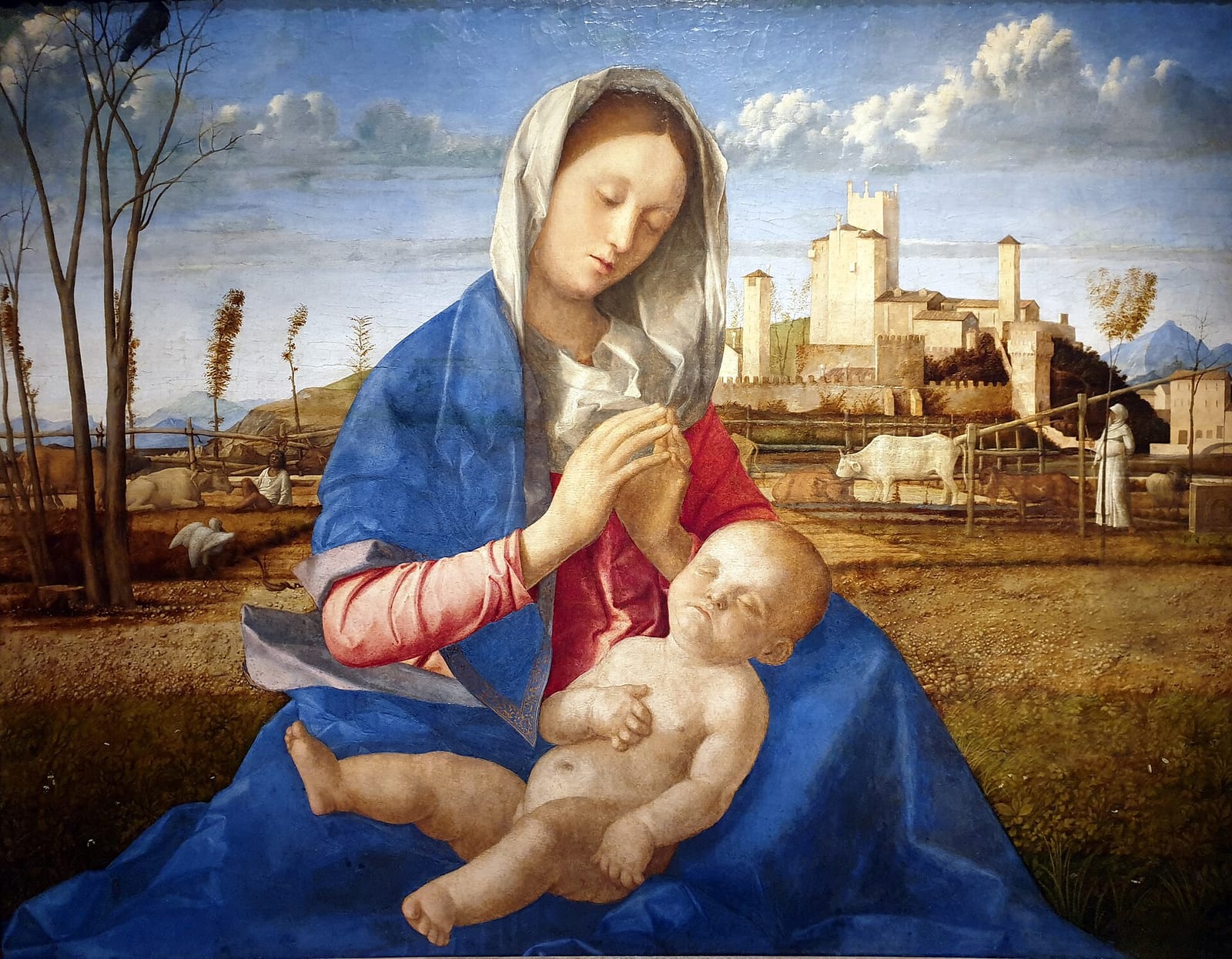
Stand in front of a Titian for a while and the reds start to separate. What looked like one red becomes a warm madder in the shadow, a cooler scarlet in the half-light, and near the highlight a passage that seems to turn to gold and then back to red. Critics have long called this Venetian colour. It did not come from expensive pigments alone. Over three generations, the painters of Venice worked out a new way of handling light, and painters today still use it, whether they know it or not.
The Invention of Tonal Colour
Before Venice, the usual approach in Italy, taught in Florence and followed by painters such as Botticelli and Raphael, was local colour. Each object had its "true" colour, and the painter modelled it in light and shade using lighter and darker versions of that same colour. The Venetians, working in a humid city lit by light reflected off the lagoon, came to see it differently: colour belongs to the light falling on a surface as much as to the surface itself, and a shadow changes temperature as well as growing darker.
Titian's late work shows this most clearly. In his last mythologies and his late self-portrait, he uses colour so freely that many historians see in it a forerunner of Impressionism, three centuries early. Forms are suggested rather than drawn, and colour does the structural work that line used to do. The paintings look different in morning and afternoon light, and change as you walk past them. Photographs never quite catch them.
Tintoretto and the Organisation of Space
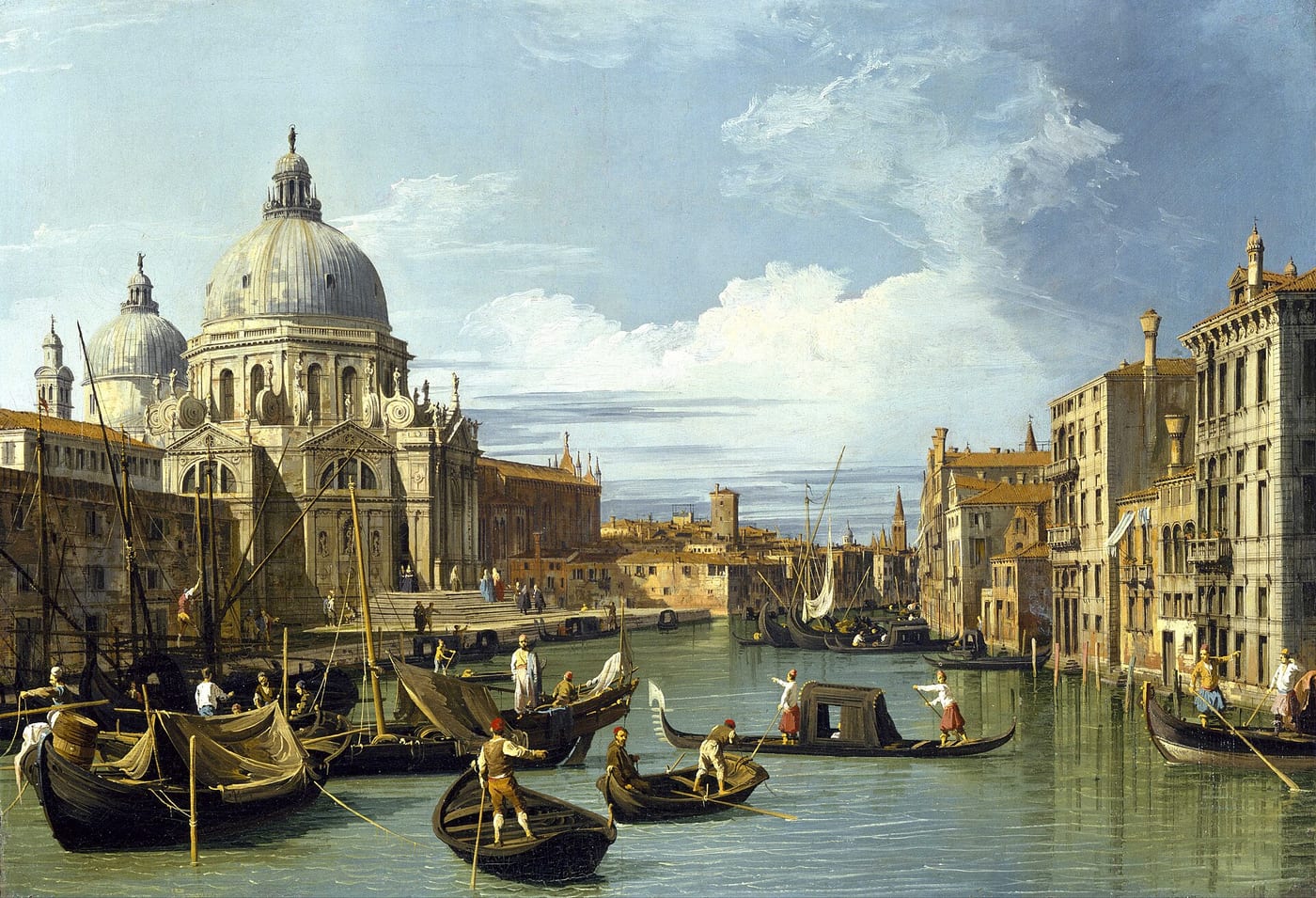
Where Titian used colour to describe light, Tintoretto used it to build space. In his huge canvases for the Scuola Grande di San Rocco, a commission that occupied him for more than twenty years, figures fall back into the darkness by turning cooler, bluer and greyer, as well as smaller. Warm tones come forward and cool tones sink back, so the colour carries as much of the depth as the perspective does.
That idea, that warm colours advance and cool ones recede, is now one of the first things a painting student learns. Tintoretto used it with a force few painters before him had attempted.
The Conversation That Never Ended
The painters who came to Venice in the nineteenth century, Turner first among them and later Sargent and Whistler, came for more than the buildings. The light on the water and stone, reflected back and forth, was everything the Venetian painters had worked out, there to be seen in front of them. They went home with it confirmed by their own eyes.
A painter working in oil today draws on the same inheritance whenever they mix a warm shadow, cool a background to bring the foreground forward, or let colour carry what the drawing cannot. The question Titian took up, how to make light out of pigment and depth out of a flat surface, has never been settled. Each new canvas tries again.